Karlsruhe Institute of Technology | Clip 1
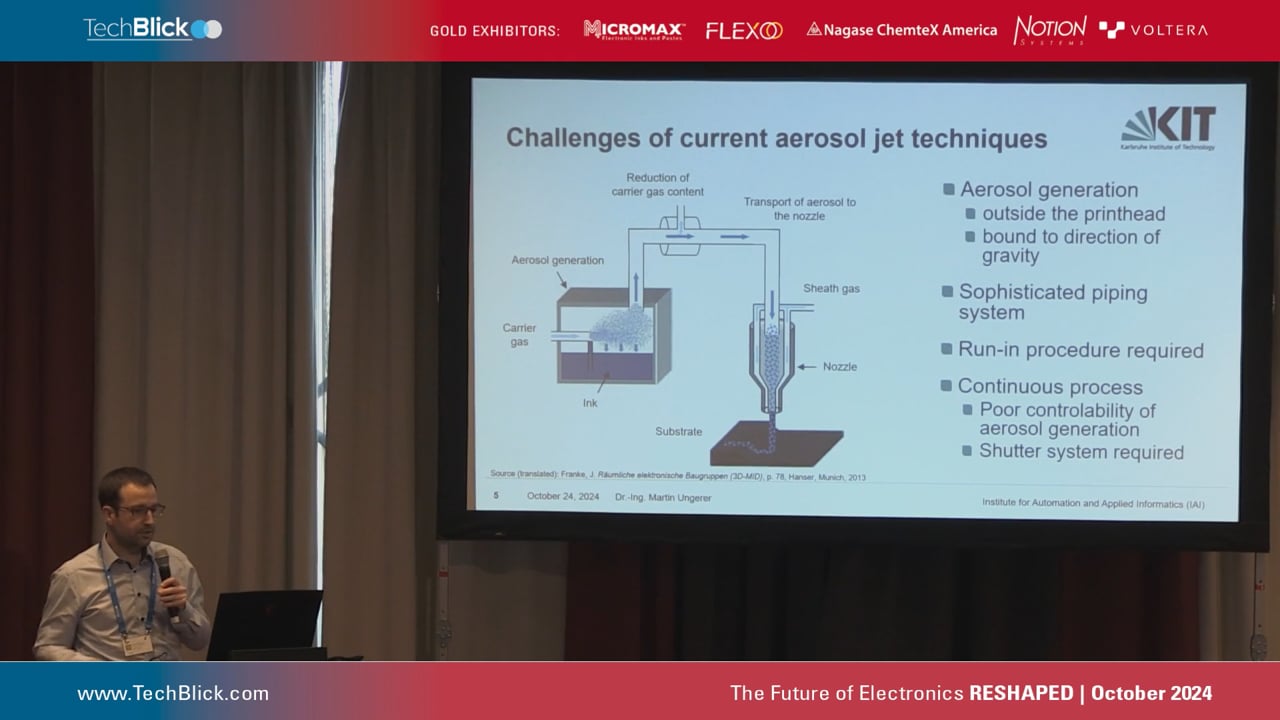
Why do today's leading aerosol jet printers need 15 minutes to warm up and a mechanical shutter just to print a simple line?
Conventional aerosol jet systems, the current state-of-the-art for printing electronics on 3D surfaces, rely on an architecture with inherent limitations. The aerosol is generated in an external atomizing unit that contains a free ink surface. This design choice immediately restricts the entire printhead system, making it dependent on the direction of gravity and unable to operate in arbitrary orientations.
The generated aerosol must then be transported from the atomizer to the actual printhead through a long tubing system. Inside the printhead, a sheath gas is used to focus the aerosol stream into a fine jet. This extended transport path not only introduces potential for material waste and clogging but also significantly complicates the process of changing inks, requiring extensive cleaning of multiple components.
These architectural choices lead to significant operational drawbacks. A long "run-in" period, lasting anywhere from five to fifteen minutes, is required for the aerosol jet to become steady and stable. This makes it impractical to start and stop the aerosol generation during a print job. Consequently, the jet must be operated continuously, necessitating a complex and potentially unreliable mechanical shutter to block the jet when not printing, which is essential for creating the discontinuous patterns found in electronic layouts.
In this short video, you can learn:
* The gravity-dependent architecture of standard aerosol jet systems.
* Why a long run-in period is required before printing can begin.
* The need for a mechanical shutter system for printing electronic layouts.
� **Clip Abstract**
Conventional aerosol jet printing for 3D electronics faces significant challenges, including gravity dependence, long stabilization times, and the need for complex shutter systems. These limitations stem from an architecture where the aerosol is generated externally and transported through long tubes.
� Link in comments �